
The Silver Lake Drawdown: Lessons in Communication and Stewardship
By: Alison Brown, Co-Director, Henrys Fork Wildlife Alliance
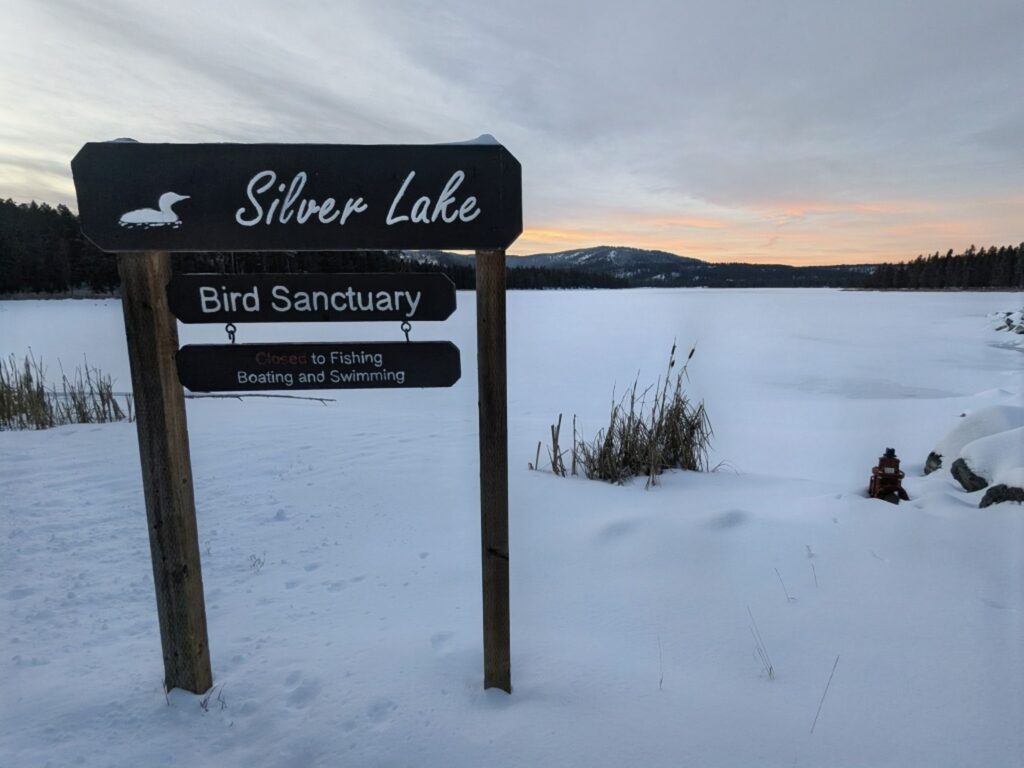
We’re sharing this statement in response to overwhelming interest from our community and supporters about the drawdown of Silver Lake that occurred at Harriman State Park in November 2025. Our goal is not to speculate or assign blame, but to offer transparency that can help our community better understand what occurred, to outline why this event matters for the Henrys Fork watershed and the wildlife that call it home, and to explore how similar impacts can be avoided in the future.
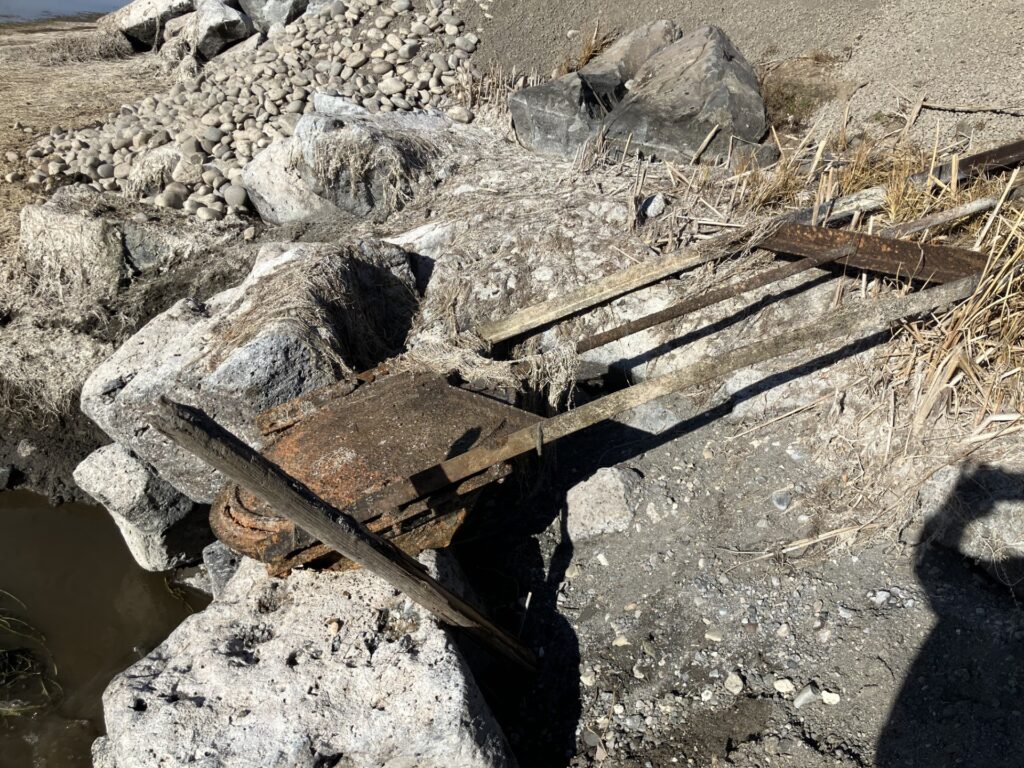
On paper, the work planned for Silver Lake sounded routine. At an Idaho Department of Parks and Recreation (IDPR) quarterly board meeting on February 4 20251, a maintenance project—Harriman Dike and Culvert Repairs—was listed among several infrastructure projects. The project, intended to repair the Silver Lake culvert and headgate, was reportedly in the design phase with construction documents 90 percent complete. Reports from the quarterly board meeting held on September 16, 20252 indicated that IDPR was “working through permitting for culvert and headgate repair at Silver Lake.” A final update from a quarterly board meeting held on November 4, 20253 reported that bidding had commenced and construction was predicted to start in Fall 2025. In other words, this was not an emergency repair pulled together overnight, but a project that had been in the works for months.
On November 7, 2025, Harriman State Park posted on social media that Silver Lake was being actively lowered, signaling that the proposed work had commenced. The post said work would begin in about a week and last just a few days. The announcement attracted little public attention—perhaps because many assumed that permitting, environmental review, and coordination had already been handled behind the scenes. Over the following days, visitors to the park began posting to social media channels that the water level of the lake was dropping rapidly.
In blog posts from the Henrys Fork Foundation (HFF) dated November 214,5 and December 10, 20256 it was revealed that HFF staff noticed something was wrong as they conducted unrelated, routine water monitoring. They observed signs of recent high flows in Thurmon Creek’s floodplain and visibly elevated turbidity in Thurmon Creek and the Third Channel of the Henry’s Fork. HFF announced it was collecting water samples and documenting conditions with aerial imagery. What those images showed raised alarm bells: a large sediment plume pouring out of Silver Lake, down Thurmon Creek, and into the Third Channel of the Henrys Fork.
On November 24, Harriman State Park posted on social media that the lake was being “temporarily and slowly lowered” to reduce impacts to wildlife habitat. Meanwhile, community members continued to comment that the lake appeared empty and posted images and videos showing sediment-laden water flowing into Thurmon Creek. On November 25, the Henrys Fork Wildlife Alliance (HFWA) received a video from a concerned resident in which a western painted turtle crosses a broad expanse of mud and exposed vegetation. On November 25th or 26th the outlet culvert of the lake was capped and the lake began to refill slowly. The culvert and headgate repairs had not been completed.
The drawdown of Silver Lake and the resulting sediment plume was concerning because sediment in rivers isn’t just muddy water—it can smother aquatic insects and vegetation, clog fish gills, fill spawning gravel, and alter habitat far downstream. Dewatering the lake could impact native species like the western painted turtle whose winter survival depends on burrowing into the soft mud at the bottom of lakes and ponds and entering a state of torpor. To survive in the mud for months, their metabolism drops by as much as 95 percent and they absorb oxygen directly through their skin. This remarkable strategy only works if there is water—and mud—above them. When Silver Lake was drained, turtles were suddenly exposed, forced to move across open ground and contend with dropping air temperatures in search of a new place to burrow.
Painted turtles aren’t the only species that depend on Silver Lake for winter habitat. According to the Idaho Department of Fish and Game (IDFG)7, the lake provides critical habitat for trumpeter swans, a Species of Greatest Conservation Need and a species designated as Sensitive by the Bureau of Land Management. Winter surveys conducted in the early 2010s documented roughly 400 swans wintering in the Island Park area, relying on open water in Silver Lake, Golden Lake, Thurmon Creek, and the Henrys Fork River. Protecting trumpeter swans requires more than just open water—it requires undisturbed wetlands, high water quality, and buffers from human disturbance, especially during winter, when energy demands are high and food is scarce.
The Silver Lake drawdown matters because it’s about how decisions ripple through a living system—affecting turtles beneath the mud, swans on winter water, fish downstream, and a river system treasured by people across the region. Our focus now is on understanding what went wrong, what can be learned, and how future projects can better balance the requirements of infrastructure maintenance and upgrades with the needs of our treasured native wildlife that depend on our public lands.

The Rules Meant to Protect Water and Wildlife
As the dewatering event progressed and public concern mounted, HFWA met with stakeholders and non-profit conservation groups working in the area to learn about the situation. We requested a meeting with the Director of IDPR seeking clarity and conversation on December 8, 2025 and and again on January 30, 2026. Those meeting requests went unanswered, leaving us with unresolved questions. With little public information available, we submitted records requests to key agencies to better understand what planning, permits, and safeguards were in place. We watched and listened and learned.
In response to one of our public records requests to IDPR we received a copy of the U.S. Army Corps of Engineers (USACE) Nationwide Permit 33 (NWP 33)8. This appears to be the permit IDPR believed they were working under to repair the culvert and headgate at Silver Lake. A subsequent records request revealed possible miscommunication between IDPR and USACE but we’ll get to that shortly. For now, let’s assume that IDPR was conducting the Silver Lake headgate and culvert work under NWP 33.
Nationwide permits can cover requirements of Section 404 of the Clean Water Act and are intended to streamline approval for activities that are expected to have minimal environmental impacts. They are designed to reduce paperwork and delays—but only when projects stay within strict limits. If impacts exceed those limits, the project must instead go through an individual permit process, which requires greater coordination, review, and oversight.
Nationwide permits require a Water Quality Certification (WQC) which ensures that requirements of the Clean Water Act Section 401 are adhered to. In Idaho, a WQC is issued by the Idaho Department of Environmental Quality (IDEQ) and confirms that a project meets state water quality standards. Importantly, a nationwide permit is not valid unless the associated water quality certification is granted, waived, or conditioned.
The permit IDPR provided to us in response to our records request—NWP 33—allows for temporary construction, access, and dewatering, but only if specific conditions are followed. Upon review of the permit conditions, several non-compliance issues were identified:
1. Turbidity Monitoring: No Evidence of Compliance
The WQC requires turbidity monitoring whenever a project discharges water into Waters of the United States and produces a visible sediment plume. Daily turbidity logs must be kept and made available to IDEQ upon request. Exceedances and corrective actions must be documented.
- Silver Lake dewatering began on November 7 with no evidence of turbidity monitoring.
- The first documented turbidity measurements were collected on November 19 by HFF staff. Staff from IDEQ collected additional measurements on November 20.
2. Turbidity Limits: Exceeded
Idaho’s water quality standards are clear. Turbidity may not:
- Exceed background levels by more than 50 NTU instantaneously, or
- Exceed background levels by more than 25 NTU for more than 10 consecutive days.
According to HFF6, background turbidity in this system is around 3 NTU but measurements taken at Silver Lake, Thurmon Creek, and the top of the Third Channel showed turbidity levels nearly 100 times higher than background, far exceeding allowable limits. In a matter of weeks, the dewatering event appears to have added as much sediment into the Third Channel of the Henrys Fork as the tributaries between the Buffalo River and Pinehaven deliver to the river in a 6 – 12 month period.
Had IDPR been conducting the required monitoring, permit conditions would have required the following actions, none of which occurred for days or weeks after dewatering began:
- Immediate stoppage of earth-disturbing activities once turbidity thresholds were exceeded,
- IDEQ notification, and
- Corrective action
It is also worth noting that NWP 33 includes a condition to control sediment in even small dewatering events–including cofferdams. So, it’s difficult to reconcile that IDPR would presume that dewatering a 600-acre-foot lake would require no sediment control at all.
3. Maintaining Pre-Construction Water Flows: Not Achieved
Another permit condition requires the permittee to maintain, to the maximum extent practicable, the pre-construction course, condition, capacity, and location of open waters during construction to avoid erosion and sediment mobilization.
- HFF estimates that the natural baseflow of Thurmon Creek during fall 2025 was approximately 5 cubic feet per second (cfs). The average flow during the four day dewatering event increased to 75 cfs–a dramatic increase in the capacity of the flow. They also observed grasses and vegetation downstream of Silver Lake bent flat by recent flows6—physical evidence that the creek had exceeded its pre-construction condition and capacity.
4. Sediment Control Measures: Absent When Most Needed
NWP 33 and the associated WQC requires that soil erosion and sediment control measures (often referred to as Best Management Practices, or BMPs) be installed and maintained in effective operating condition throughout construction to protect water quality, with daily monitoring to ensure those practices are effective.
Observations from the event indicate:
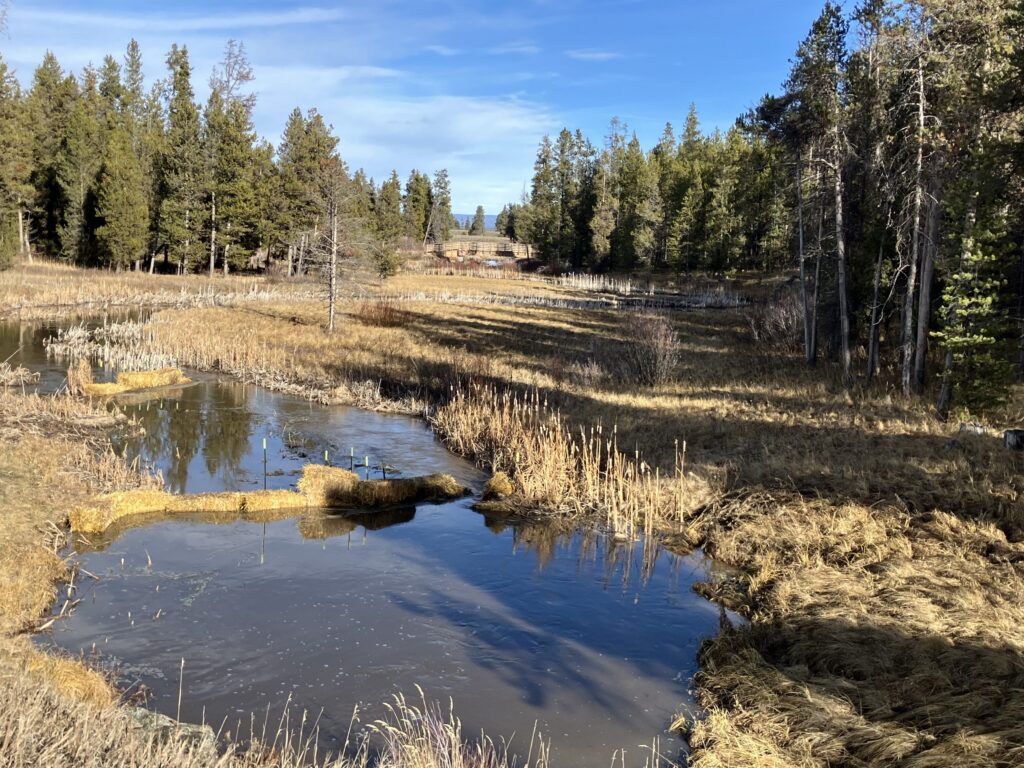
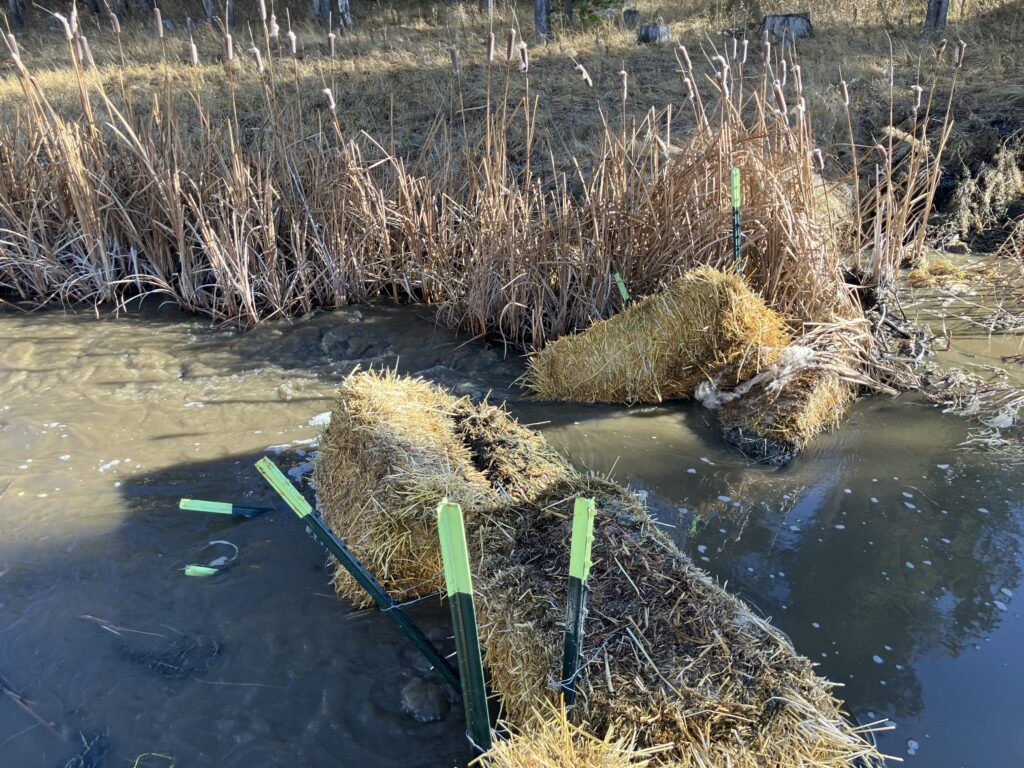
- Dewatering began without BMPs in place. Photographs collected by HFF on November 20 did not show sediment control measures being implemented, and subsequent email correspondence from IDEQ staff referenced the release of water without the use of BMPs.
- Straw bales were installed as a sediment control measure between November 20 – 23. The bales are visible in multiple videos and images from November 23. However, a breach can be observed in the straw bales where sediment-laden water flows freely past the sediment control structure.
5. Coordination With IDFG: Unclear or Absent
IDFG is the state’s primary agency for fish and wildlife stewardship. Activities in select waters and wetlands may necessitate coordination with IDFG including:
- Those located in the Henrys Fork and its tributaries,
- Wetlands identified in Idaho Department of Fish and Game, Wetland Conservation Strategy9 as Class I, Class II and Reference Habitat Sites. Thurmon Creek is identified as a Class II wetland.
Documents received through public records requests do not include IDFG consultation but investigations are still ongoing.
A Breakdown in Communication?
Documents received from a public records request submitted early in January 2026, suggest that the Silver Lake dewatering may have proceeded under a fundamental misunderstanding between IDPR and USACE about whether a permit was required at all.
An email dated April 29, 2025, shows that a USACE Environmental Resources Specialist told an IDPR staff member that the primary activity—repairing a damaged headgate or performing maintenance on the existing culvert—likely would not require a USACE permit. In that same email, USACE attached a copy of NWP 33 and noted that if IDPR wanted a formal, project-specific authorization letter, they could apply for one, but in USACE’s view it did not appear necessary or particularly beneficial at that time. It appears the IDPR staff member may have interpreted the attached permit as authorization to proceed, rather than as an example of a permit that might apply, dependent upon project-specific plans.
On December 3, 2025, IDPR submitted a plan to USACE outlining steps to address turbidity concerns, including the installation of sediment control measures (including filter fabric, straw bales, and a turbidity curtain), daily turbidity monitoring, and use of a cofferdam during construction activities. IDPR also indicated that it would continue developing a plan to address sediment that had accumulated in Thurmon Creek.
A USACE memorandum dated December 4, 2025 provides some commentary on the April 29th email between IDPR and the USACE Environmental Resources Specialist. The document claims that the email was a follow-up to a phone conversation in which USACE stated that the headgate repair itself would not require an individual permit as described, but that associated construction activities might. During that conversation, IDPR reportedly indicated they would use a cofferdam, prompting USACE to explain that dewatering within a cofferdam could fall under NWP 33. USACE sent the permit and water quality certification as example documents so IDPR could review whether their project needs would be met. They recommended that if IDPR wanted confirmation, they should submit a Joint Application for Permits to obtain a formal Verification Letter. Since this conversation was reportedly communicated over the phone, we can not confirm what was discussed.
It seems that the Joint Application was never submitted. USACE received no follow-up communication from IDPR prior to construction, and no Verification Letter was issued. As a result, it appears IDPR may have proceeded under the assumption that their work was covered under NWP 33 when, in fact, the permitting process had not been completed.
On December 15, 2025, IDPR received a formal Notice of Violation from USACE. The incident remains under investigation to determine whether violations occurred, the extent of any impacts, and what resolution may be appropriate.
On January 13, 2026 a Public Service Announcement appeared on the Facebook page for Harriman State Park with an update on the Silver Lake work. It said that work had stopped due to winter weather and the project would resume in the spring with anticipated project completion by early summer. It also stated that IDPR is coordinating with USACE.
A Shared Path Forward
Managing public lands and infrastructure is complex, and agencies like the IDPR are often tasked with meeting critical safety, maintenance, public access, and conservation objectives with limited staffing, funding, and time. These constraints require difficult decisions and tradeoffs, especially when aging infrastructure intersects with sensitive natural resources. Recognizing the challenges faced by IDPR is an important part of having a productive conversation about how projects are planned, communicated, and implemented.
If you visit Harriman, take a drive along Silver Lake—you’ll find the lake refilled, quiet, and covered with winter ice. Looking toward Thurmon Creek, you’ll see a turbidity curtain holding sediment in place to help protect downstream habitat. And behind that peaceful scene, agencies like IDPR, USACE, and IDEQ are working diligently to investigate this event and coordinate next steps—both to complete the much-needed culvert and headgate repairs and to address the sediment that accumulated during the drawdown.
As plans move forward and future projects take shape, we will be advocating for IDPR to commit to early documented coordination with permitting agencies, to identify clear permit confirmation before work begins, and to engage in proactive communication with partners and the public when projects affect shared waters and wildlife habitat. Taking these steps upfront will ensure that projects meet their objectives while preventing costly delays, emergency responses, and environmental damage—saving money, time, and limited resources. We have an opportunity to improve collaboration and transparency between agencies, scientists, and communities to strengthen trust and improve outcomes for both people and wildlife.
How our public lands are managed matters and public engagement is essential. Keep asking questions, sharing what you witness on the ground, and stay involved. We are committed to continuing this dialogue, pushing for greater transparency in decision-making to improve future outcomes. We’ll share updates as new information becomes available.
Sources
1 IDFG Quarterly Board Meeting February 4, 2025 (pg. 30)
2 IDFG Quarterly Board Meeting September 16, 2025 (pg. 89)
3 IDFG Quarterly Board Meeting November 4, 2025 (pg. 20)
4 Silver Lake Sediment Event: What Happened, What We Saw, and What We’re Doing About It
5 FAQ: Silver Lake Sediment Event
6 Estimation of Thurmon Creek sediment load following the drawdown of Silver Lake
8 USACE Nationwide Permit 33 – provided by IDPR during public records request, Dec 2025
9 Conservation Strategy For Henrys Fork Basin Wetlands, IDFG, Apr 1996 (pg. 22, 24)