
SB 1300: A Threat to Nonpartisan Natural Resource Management
By Alison Brown
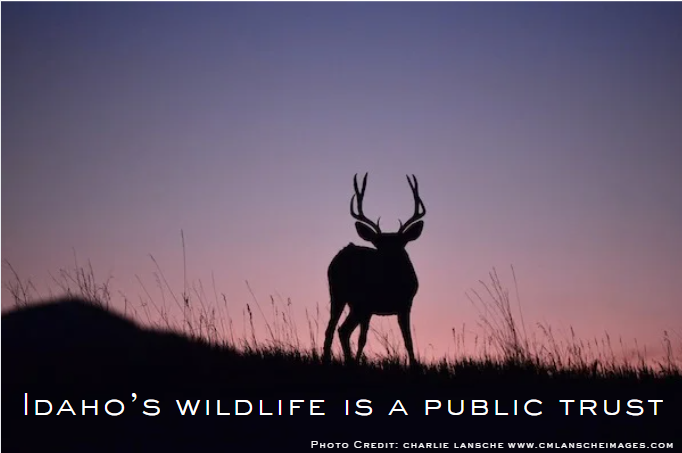
SB 1300, currently under consideration by the Idaho House State Affairs Committee, would concentrate the authority to appoint directors of the Idaho Department of Fish and Game (IDFG) and Idaho Department of Parks and Recreation (IDPR) with the Governor. The bill threatens to overturn the legacy of Idaho citizens who––after decades of debate and an eventual statewide consensus––deliberately chose a nonpartisan, commission-based system to govern its natural resources.
Idaho’s Fish and Game Commission (Commission) and its responsibility to appoint the director of IDFG was not created casually nor out of convenience. It was the result of three decades of effort by Idaho sportsmen who sought to remove fish and wildlife management from partisan politics and place it on a scientific, merit-based foundation.
Throughout the 1910s and 1920s, sportsmen’s groups repeatedly proposed legislation to establish a nonpartisan commission, protect license revenues from diversion, and ensure that employees were hired and retained based on merit rather than politics. These proposals passed one chamber multiple times, but were vetoed, defeated, or allowed to die in the Legislature.
By the 1930s, frustration had grown. Sportsmen across Idaho formed coalitions, including what became the Idaho Wildlife Federation, and ultimately turned to a ballot initiative after legislative reform efforts failed. In 1938, after gathering more than 24,000 signatures in just seven weeks, Idaho voters overwhelmingly approved the initiative establishing the Commission—earning 76% of the total vote and a majority in every county.
The structure adopted by voters was deliberate, creating a five-member commission with staggered terms, partisan protection (no more than three members from one political party), and authority to hire a director. Commissioners served without pay and employees would be hired on merit and could be removed only for cause. The Commission determined seasons and bag limits and oversaw wildlife management under a policy that wildlife would be “preserved, protected, perpetuated and managed.” Since its establishment, the Commission has expanded to seven members, each representing a distinct geographic region. Members serve staggered four-year terms with a two-term limit, and are now compensated for their service. Partisan protection remains––no more than four members from the same political party can serve on the Commission at once. Importantly, the Commission still retains the power to hire the IDFG Director.
IDPR was established in 1965 by Governor Smylie who intentionally adopted a governance model similar to that of IDFG. The agency was placed under the oversight of a six-member board––each member represented a distinct geographic region––rather than direct political control. The IDPR Board of Directors (Board) was granted the authority to appoint the agency’s director. This structure was designed to promote professional, nonpartisan management of Idaho’s parks and recreation resources and to provide stability and continuity beyond any single administration. By vesting hiring authority in a representative board rather than a single elected official, Idaho affirmed that stewardship of our public lands and recreation opportunities should be guided by long-term public interest rather than shifting political priorities.
Fluctuations in natural resources play out over long time periods and effective management depends on consistency and stability––the current governance structures of both IDFG and IDPR were designed specifically to insulate natural resource management from short-term political pressures. Fish, wildlife, and public lands belong to all Idahoans and sound management requires continuity, expertise, and public trust. By preserving the current structure in which directors of IDFG and IDPR are appointed by the Commission and Board, respectively, we uphold the vision of shared natural resource management that is guided by science, long-term stewardship, and broad public interest—not by shifting political dynamics.
It is important to recognize that the Commission’s independence was not accidental—it was hard-won and explicitly intended to safeguard wildlife management from political influence. Establishment of the Board deliberately followed that same model. Management of our shared natural resources should not operate on election cycles or under political pressure.